
Wellness · Tradition · Copper
9 min read
The Morning Fist Test — and What Changed on Week Three

Every morning I do the same thing before I open my eyes.
I make a fist. Both hands. Under the covers. Before my feet hit the floor, before I check my phone, before I do anything — I close both hands and see what I’m working with today.
If you’re over fifty and your hands have started reminding you of that fact every single morning, you know exactly what I’m talking about.
Some mornings they close fine. Those are the good mornings.
Some mornings the right one makes it about halfway and stops, and there’s that deep, stiff ache at the base of the thumb that says — not today. Not all the way. You’ll get about seventy percent of your hands today, and you’ll have to plan around that.

The small things you stopped doing
The jar lids. The buttons. The car keys when it’s cold and your fingers feel like they belong to someone else. The way you’ve started using your left hand for things your right hand used to do without thinking, and you didn’t even notice the switch until one day you did.
The gardening you used to do for hours on a Saturday that now leaves your hands aching by noon. The handwriting that used to be neat and is now a negotiation between your brain and your grip. The grandchild whose hand you hold a little more loosely because squeezing hurts and you don’t want them to feel you flinch.
None of these things happened overnight. That’s the part nobody warns you about. It’s a slow fade — so gradual you don’t notice you’ve been compensating until you catch yourself opening a water bottle with your teeth because both hands are having a bad day.

And the word you keep hearing — from your doctor, from your friends, from the voice inside your own head — is “aging.” As if that’s an explanation. As if naming it is the same as understanding it.
What’s actually happening in your hands
Your hands are the farthest point from your heart. The blood that reaches your fingertips has traveled the longest distance in your body to get there, through the smallest vessels you have, against gravity, through tissue that gets less flexible every year.
When circulation slows — and it does slow, gradually, as part of the body’s natural progression — the extremities feel it first. Hands. Feet. Fingers. The places farthest from the engine.
Less circulation means less warmth. Less oxygen reaching the tissue. More stiffness in the morning. Slower recovery after a long day of use. The cold that settles into your fingers in November and doesn’t fully leave until April.
This isn’t a disease. It’s not a diagnosis. It’s the body doing what bodies do over time — and the options you’ve been given for dealing with it are limited and mostly unsatisfying.
🧤 Compression gloves
Help when you wear them. Can’t wear them in public without feeling like you’re broadcasting a condition you’d rather keep private.
💊 Over-the-counter pills
Systemic. A tiny fraction of the dose reaches your hands. The rest goes everywhere else, including your stomach lining.
🔥 Heating pads
Ten minutes of warmth. Then back to baseline. You can’t carry a heating pad to the grocery store.
🌿 Supplements
Maybe they work. If your gut absorbs them. If they reach the right tissue. If you remember to take them. A lot of “ifs.”
None of these are wrong. None of them are enough. And none of them are there at 5 AM when you make a fist under the covers and wait to find out what kind of day it’s going to be.
What your grandmother’s generation knew
Before compression gloves. Before joint supplements in a bottle. Before anyone used the phrase “wellness product.” There was copper.
Copper has been worn against the skin for thousands of years — not as decoration, and not as a trend. Ancient civilizations across the world placed copper on the body, particularly on the wrists and hands, as part of daily life. The tradition survived the fall of empires, the rise of modern medicine, and every fad that came and went in between.
It survived because grandmothers kept wearing it. And their granddaughters watched, and eventually did the same.
“My mother wore one. Her mother wore one. They believed the Lord put copper in the earth for a reason, and the reason was our bodies.”

Nobody in that generation needed a study to tell them why they liked wearing copper. They had their own hands, and the observation that the women who wore it kept using theirs — kept gardening, kept knitting, kept buttoning their own coats — longer than the women who didn’t.
The tradition didn’t come with a mechanism or a white paper. It came with a quiet piece of metal on the wrist and decades of lived experience passed from mother to daughter without fanfare.
Why copper. Why the wrist.
Your wrist is one of the most vascularized points on your body. The blood vessels sit close to the surface. The pulse you feel when you press two fingers to the inside of your wrist — that’s how close the circulation runs.
Copper is a trace element your body already uses. It’s present in every cell. It plays a role in the formation of red blood cells, the maintenance of connective tissue, and the function of the immune system. Your body doesn’t treat copper as a foreign substance — it recognizes it.
When solid copper sits against the skin at the wrist — continuously, day and night, through every shower and every night’s sleep — trace amounts interact with the skin’s surface at the point where circulation runs closest.
Not for ten minutes like a heating pad. Not once a day like a pill. Continuously. Passively. Without you having to remember anything or schedule anything or apply anything.
That’s what made the tradition work for generations of women who didn’t have access to pharmacies or specialists or Amazon. They wore something simple, they wore it every day, and over weeks and months, they noticed what they noticed.
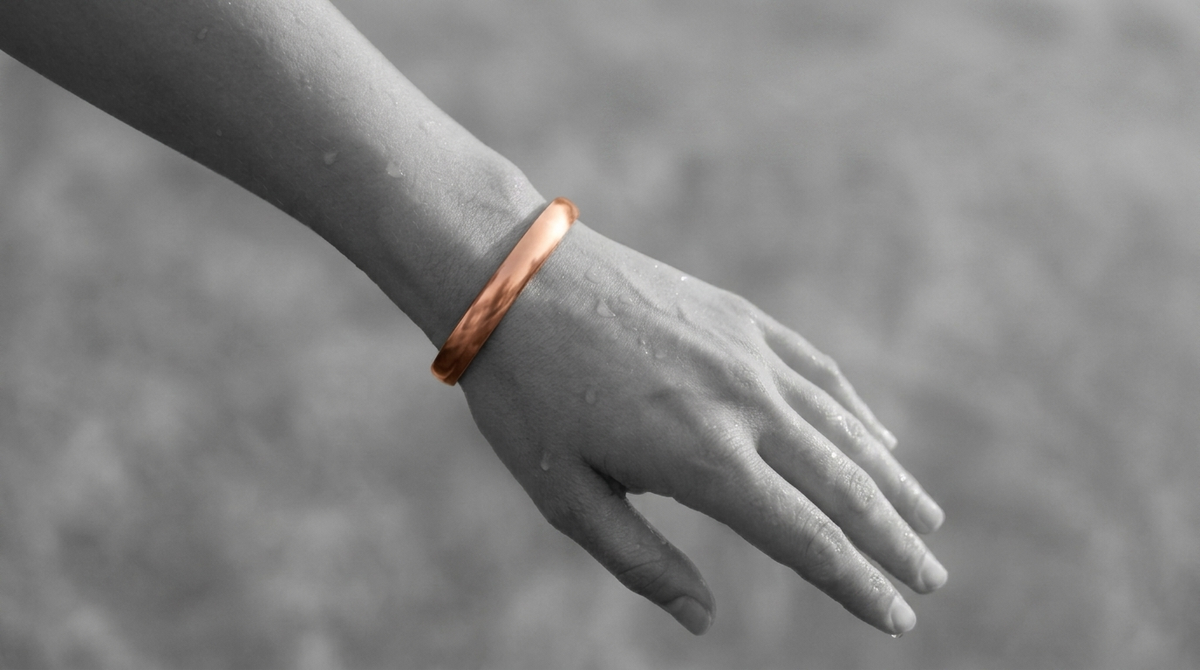

Cavizio Pure Copper Cuff
100% solid copper. Hand-made in Italy. The tradition, made beautiful.
What changes — and when
If you’re the kind of person who wants a miracle on day one, this isn’t for you. Copper doesn’t work like a pill. There’s no immediate rush, no instant effect, nothing you’d notice in the first hour or even the first week.
What there is — and this is what women who wear copper consistently describe, in their own words, over and over — is a gradual shift. Something you notice in retrospect rather than in the moment.
Week 1
Nothing. You feel nothing different. You get used to the weight on your wrist. You start to like how it looks — it’s genuinely beautiful, warmer and richer than gold-tone, and people notice it. But physically? Nothing yet.
Week 2
Still nothing obvious. You’ve stopped thinking about the bracelet — it’s just part of your wrist now, the way a watch becomes part of your wrist. You might notice the copper developing a subtle patina. That’s normal. That’s the material living on your skin.
Week 3
This is where it starts. Not dramatically. You reach for something with the hand you’d stopped reaching with — and you don’t notice until after it’s already happened. You make a fist on a Wednesday morning and both hands close all the way. You unscrew a jar lid and realize you didn’t switch to your left hand first. Small things. Ordinary things. The kind of things that used to be automatic before they stopped being automatic.

Month 2+
The new normal settles in. You stop doing the morning fist test because you’ve stopped needing to. Your hands just work — the way they used to — and the bracelet is just there, the way it’s been there every day, doing nothing dramatic and everything quiet.
That’s not a sales pitch. That’s a Tuesday. But if you’ve been living inside mornings where you negotiate with your own hands before you can start your day — a boring, ordinary Tuesday where your hands just work is worth more than any miracle claim.
Why it has to be the right copper
Most copper bracelets sold online are not solid copper. They’re a thin copper coating over a base of zinc or nickel — the same mystery-metal construction as cheap costume jewelry, just in a different shape.
The plating wears through within weeks. The base metal underneath doesn’t behave like copper on the skin, because it isn’t copper. Whatever benefit generations of women found from wearing real copper on their wrists — it doesn’t apply to a bracelet that stops being copper the moment the coating dissolves.
That’s why the entire category of copper bracelets has a mixed reputation. For every one real bracelet, there are fifty fakes. And the fakes don’t deliver, so people assume the whole idea doesn’t work — when really, they just never wore actual copper in the first place.
Cheap “copper” bracelets
✕ Copper-plated over zinc or nickel
✕ Coating wears through in weeks
✕ Machine-stamped, mass-produced
✕ Lightweight, hollow, feels disposable
✕ $15–25 — and worth less
Cavizio Pure Copper Cuff
✓ 100% solid copper throughout
✓ Same material day 1 as day 1,000
✓ Hand-made in Italy
✓ Real weight, luxury feel and finish
✓ More value — buy one, give one
What they noticed after week three
“I wear it every day. The morning stiffness that used to take an hour to loosen up is just... less. I didn’t notice the change happening — I noticed it had already happened. My hands feel like my hands again.”
— Verified Cavizio customer
“My mother wore a copper bracelet until she was 91. I always thought it was superstition. Started wearing one myself last winter because my hands were cold all the time. I understand now why she never took hers off.”
— Verified Cavizio customer
“I bought it because it’s beautiful — genuinely the nicest bracelet I own. But I keep wearing it because of what I noticed after about three weeks. I can open jars again without switching hands. I didn’t expect that.”
— Verified Cavizio customer
“I got the BOGO and gave the second one to my sister. She called me four weeks later and said her hands feel different. She couldn’t explain it either. Neither of us tried to. We just kept wearing them.”
— Verified Cavizio customer



A piece of jewelry that earns its place on your wrist
Cavizio makes one product. A bracelet. Hand-made in Italy from 100% solid copper — not plated, not blended, not hiding anything under the surface.
It looks like luxury jewelry because it is luxury jewelry — the warm copper tone is richer and more complex than gold, the weight is substantial in the hand, and the craftsmanship is visible in every curve. People will ask you where you got it before they ask you why you wear it.
But why you wear it is the part that matters.
You wear it because your grandmother’s generation wore copper every day and never stopped using their hands. You wear it because the tradition survived longer than any product on a pharmacy shelf. You wear it because it’s the one thing in your routine that asks nothing of you — no schedule, no application, no remembering — and gives you back something you thought you were losing.
You put it on in the morning. You forget it’s there. And at some point, you reach for something with the hand you’d stopped reaching with, and you don’t even notice until it’s already done.
100% solid copper. Italian hand-made. Keep one and give one to the woman who taught you what your hands are for.

Cavizio Pure Copper Cuff
Hand-made in Italy · 100% Solid Copper
Free shipping · Satisfaction guaranteed
I wore my grandmother’s copper bracelet for three weeks before I ordered my own. Not because hers stopped working — because I wanted one that looked as good as it felt. Something I’d be proud to wear every day, not just privately, but in front of anyone.
Cavizio was that piece. Italian-made. Solid copper. The kind of quality that makes you wonder how it’s only seventy-one dollars — and then makes you glad it is, because it means you can buy two and give one to someone whose hands are starting to remind them of their age.
Put it on. Give it three weeks. Do the morning fist test. And then stop doing the morning fist test — because you won’t need it anymore.